
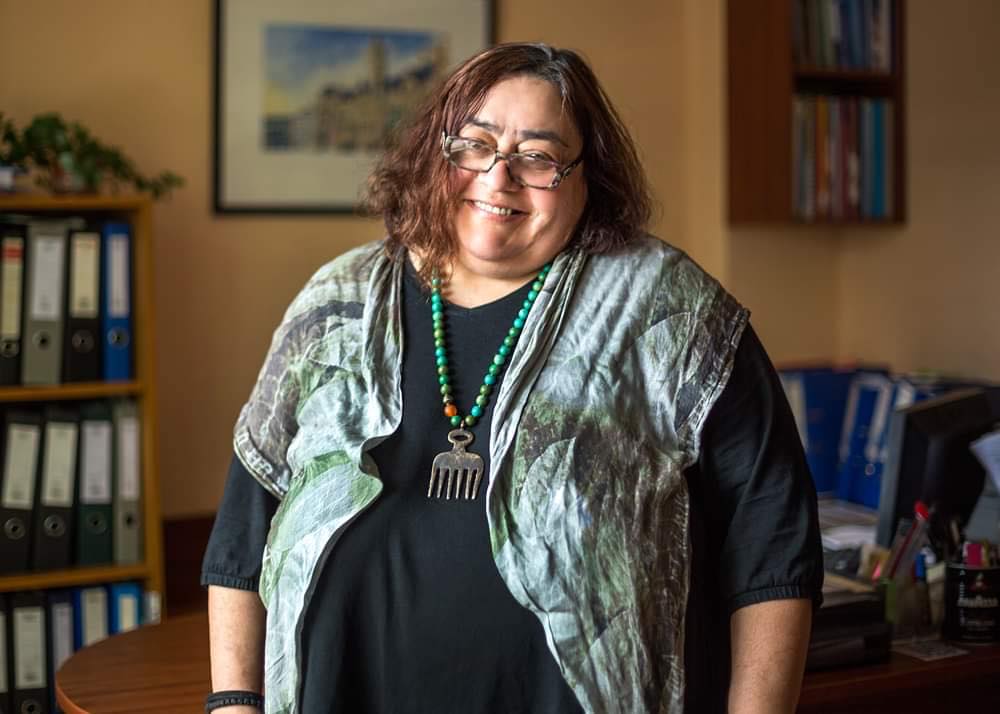
Dr. Rada Stamenkova in front of People of Sofia
I’m Dr. Radosveta Stamenkova, everyone calls me Rada, I’m 58 years old and I’ve been working in the field of health prevention and family planning for almost 30 years, and I’ve been in the field with the Roma community for almost as long. Basically, I know all about early pregnancy, early school leaving, early marriage, and the phenomenon of children giving birth to children. Not only from books and statistics, and from living life and practice.
Let’s start with this – why do children beget children? Things that are common?
First of all, let me say that according to UNICEF, child pregnancy and child marriage are considered to be anything that occurs under the age of 18. If we talk about the Roma communities, it is important to know: we cannot look at the Roma in a homogeneous whole, because they are very different – there are cities where three or more Roma groups live separately from each other, who do not intermarry , they don’t communicate much, they have different religions and languages, etc. The most appropriate is the specific, individual approach to the specific community and place. By religion, there are Eastern Orthodox Christians, there are those belonging to various evangelical denominations, there are also Roma who profess Islam. By language, they speak Romany, Turkish, the Kopanars speak a Wallachian dialect, the Tsutsumans speak Bulgarian. There are tinners, coppersmiths, burgujies, screeners, combers and many more, based on what their forefathers did back in the day.
Is there anything in common between all these groups on the topic of children begetting children?
The theme of children giving birth to children is not a Roma theme and a Roma specialty. It’s something that happens to everyone. I constantly struggle with prejudices – on the one hand, the prejudices of the majority, on the other, the prejudices of the Roma community itself. Both say that these are their traditions. Early pregnancies and early births occur in many regions of the world – mostly in poor regions. In Bulgaria, if everyone looks back in their family tree, they will see that at least three generations ago they had a great-grandmother or great-great-grandmother who married at 15 and gave birth at 16, by twenty-something years old she had already given birth 6 children, two of whom died due to some infectious disease, and the others worked from an early age, because the population lived more in the villages and needed labor. We are talking about times when the average life expectancy was 40 years, and that was only 150-200 years ago. It is currently over 80 years old in many countries. When you have a life horizon of 40 years, it is normal to get married at 15. Here a parenthesis I want to open that back then it was much easier and acceptable to say that you will live with someone for the rest of your life when you are 16 and you will live until 40. Now, it is very difficult to promise someone , when you’re 25 and your mindset isn’t what it was when you were 16, that you’ll love him until he’s 80. This is in connection with the changed attitude towards marriage as an institution – people no longer stay together as much as our grandparents, who were brought up that whatever happens in the family we have to endure. Well, this entire preamble is to say that children give birth to children is not a Roma specialty, they did not invent it and they did not bring it to Bulgaria. Here we must note that Bulgaria is different from India, from the point of view of “little brides” in that in India very often minors marry them to men who can be their fathers and grandfathers – over 50 years old. In Bulgaria, in most cases, if the girl is 13-14, the boy is 17-18. And if both are under 18, the responsibility falls on their parents – they are the ones responsible for what happens to their children – both to them and to the law. In this regard, when we work on prevention, we target not only children, but also their parents. Young people are not capable of real judgment and are not allowed to make their own decisions. On the other hand, as they say in Africa, it takes a whole village to raise a child, even if parents don’t want to marry their children, the environment pressures them. It is said to them, “All the girls got married, only yours is like this”, so that they do not feel ashamed. There are groups in which girls are suspended from school at the first menstruation, because it is considered that she has already matured and it is very scary that she will not be stolen, that she will remain a virgin, that her blood will not be “taken”, as they say, and in our country physiology is such that menstruation comes at 12, 12 and a half years, and some girls drop out of school. Here I want to emphasize something very important – there are Roma communities in which early marriages, early pregnancy and early dropping out of school are absolutely unacceptable, very rare. There are places where, in addition to graduating and taking their matriculation exams, Roma boys and girls (and girls, I emphasize) continue their university education. I have been a mentor to many such Roma who study and graduate in medicine and work in leading hospitals. Everything is very colorful. There are regions where it is one way in one village and another in the neighboring one. A lot depends on the people. From the people from whom an example is taken. Also, another important thing is for parents to know that their child, when he studies, will have a realization in the labor market. A woman used to say to me, “Why should I make my children study, since my husband has finished high school, and the neighbor is in the seventh grade, and they both work in cleaning. What has it done him that he has studied.” Come on, men stay in school, first of all, because they don’t have menstruation
and secondly, because in order to get a driver’s license they need to complete the tenth grade. There are three types of families in Roma communities. One is modern – with parents who want their children to study further and know it is important. There is a classic patriarchal family in which, after getting married, young people go to live around the boy’s family, where, despite the patriarchy, the mother-in-law is the leading figure, and the third are families who live on the edge of misery – for them the idea of survival is much more important from the idea of education and perspective.
Is poverty the biggest factor in children begetting children?
Yes. As in the whole world, the poorer and more uneducated you are, the easier it is to slip up and that’s how you have to live. At the same time, of all the mothers I’ve talked to who gave birth to their children when they were children themselves, when I asked them how they wanted their children to develop, there was not a single one who said they wanted them to be like her. On the contrary, they all respond that they will not allow this to happen. There are many cases in which this happens, but there are also cases in which it does not happen – the child has followed the mother’s model. I am reading the interviews from this project with great interest and I am happy that the examples are happy examples – of girls whose lives have gone a little wrong – they dropped out of school, when you should be carefree, go out with friends and think for your future, suddenly finding yourself a parent at 15 is an extremely difficult thing. And despite motherhood, they are back in school and have graduated or will graduate, and are building a home. These examples are of girls who had a stable person by their side as well as a supportive environment. And somehow, they were strong and built their lives from nothing, and their children learn too. I also read the comments, where there are accusations that you only show positive examples, but there is no way to see others. If your life turned out badly and at 15 you gave birth, you left your child in an institution, which happens very often, you went somewhere else, there is no way you will be “caught” for an interview and shown, and if they ask you, they will not you agree to be photographed and tell your story and declare “Yes, I failed and the child is somewhere”. If the young mother has given birth to her child and is living in extreme poverty, marginalized to the extreme with low parenting capacity, you cannot find this case.
We know such mothers, but they do not agree to be photographed. People don’t realize how brave it is for these girls to stand up with their faces and their stories and tell their lives openly.
Yes, you have found happiness because these girls have found the strength to fight it. Not everyone is like that, not everyone has that kind of power, it’s not massive.
Let’s not forget that shame is also a big factor in our public speaking.
He’s a big factor in a lot of things. We call venereal diseases shameful diseases, we call the external genitalia shameful regions, everything is shameful, great shame in everything. At home, in homes, between generations, puberty, maturation, sex, taboo topics, shameful topics are not talked about.
Is poverty, early pregnancy and birth ethnicized?
It is a big mistake to ethnicize, because this is not a problem of ethnicity, but of ethnicity. We pass by a Roma ghetto and see the miserable conditions. And in Lyulin, in Nadezhda, behind the panel walls, do we even know about the miserable conditions and poverty in which people live. In the villages, the only young and middle-aged people are Roma. The health mediators I work with tell me how in many places, elderly people, Bulgarians, turn to them for help and they help them because there is no one else. Marginalization is not ethnically based, it is a matter of poverty, of access to services, of prospects. But the stereotype is that the Roma are poor, but we are fine. “Our” Bulgarian girls don’t do that, they wear costumes, play people, sing patriotic songs and make moussaka. One of my students, who has already graduated and works as a nurse, told me “Integrated Roma are invisible”. When we go to Pirogov, we don’t see that the young and beautiful doctor who examines us is Roma, we don’t see that the cardiologist in St. Anna is Roma or that the teacher at our child’s school is Roma, but we only see the Roma woman who drags a sleeping child to the intersection and you clean the car window or beg. And, because we are kings of stereotypes, we stick the label “this is a Roma job”.
Let’s go back to the causes of early pregnancy and birth?
I started with Roma because virginity is one of the factors. Another reason is the lack of stability and perspective, not connecting the completion of education with good horizons. There are entire generations, and not only Roma, who do not know what it is like to work from 9 am to 5 pm or in two shifts. Young unemployed and young poor are extremely common and their only fulfillment is to get married. Third party, it just happens. It is very difficult to keep statistics on this topic – the reason for the phenomenon of children begetting children. We have done research, the last one is qualitative pro
We have done surveys, the latest one is a qualitative survey, but it is not representative. Here I should also note the mantra that Roma girls give birth because of benefits. No such thing. In order to receive assistance of BGN 50-100, they have to go through dozens of signatures, and even this money does not go anywhere for a family with many children. And the very idea of many children is already being revised, even among the Roma – it is no longer the case.
Is it speculated to be pedophilia?
I have already said that things are not like in India where many grown men marry underage girls. Here the girl and the groom are of a similar age – usually a few years apart. There are pedophiles in Bulgaria, but they are not there, but mainly on the Internet. We have to keep our children safe in this environment, the virtual one, where they try to hook and lure the child. At the same time, I observe, from my field work, how many grown men fornicate with boys and girls with the half-knowledge of their parents in order to live rent-free in some dilapidated house, for a lunch or two waffles. Sexual exploitation outside of marriage. Pedophiles do not marry in this way, because after a few years the girl grows up. Pedophilia is a very serious problem, but it is not in these marriages.
To what extent do stereotypes determine our behavior towards these mothers?
The question of stereotypes is my favorite. First, what is a stereotype? A preconception about something that is not based on scientific expertise and experience. Stereotypes are an extremely important factor in our lives, unfortunately. When we talk about stereotypes during the trainings I do, I always start with one of the main generators of stereotyping, which are jokes. For example, about the jokes with Bai Gagno, the Frenchman and the American, where in the end the great nations were defeated by the Bulgarian genius or his sexual power. This is such a hackneyed reaction of a small and slightly complex people. And from there on we argue with the stereotypes – the French are great lovers, the Germans are great technicians, and the Roma are dirty and steal – that’s how we live with these postulates. At the same time, Bulgarians are very hardworking and very hospitable, we have been sixth in beauty and fourth in football all our lives, and we have been living like this for decades. Based on these stereotypes, it is very difficult to give up the idea that early marriages are not our problem, that this is happening somewhere far away, in the ghettos. And it is not exactly as it is understood.
What are the fertility trends?
In big cities, we increasingly work with women who have “forgotten” that they should become mothers – mature women who need help to overcome some form of sterility. Increasingly, in the big city, people are putting off having children until they graduate, get on their own two feet, etc. In general, the birth rate is low, and one of the explanations is that many Bulgarians are born abroad, due to the emigrant wave, where the center of their parents’ vital interests is. The diaspora abroad gives birth, but this cannot be included in our statistics. Negative growth is not only a Bulgarian problem, it is a pan-European one. But, there are births under the age of 18 in Bulgaria.
You deal with prevention. What do you focus on, mainly?
It is important for young people to be informed about how to protect themselves from unwanted pregnancy and sexually transmitted diseases. The condom remains the primary preventative for both. In Roma communities, the most popular contraceptive method is the IUD. Health mediators mainly help us in this. In the middle of April, the training of a new batch of health mediators was completed – new 37. In total, there are about 310 people who work in over 160 municipalities and are the link between the vulnerable community and health and social services, and daily strive to improve communication between institutions and the communities.
Are these young girls being given psychological help and support?
The support that is sought is usually related to social cases, the health and education system. Mental health is at the same level as dental care, which is to say, none. It is very backward, because then, when there are much more important things on the agenda like survival, they do not allow themselves to think that they need such help, because the struggle for daily life is more important. Let me go back a little bit to the qualitative studies that we’ve done that I mentioned. What are the most important values in the Roma community? The top three values are children, family, rather the big family and the struggle for the well-being of the family, which are very good values. It’s very interesting that prosperity and having something to put on the table are two different things. How much did these people struggle so that it would be valuable for them to have something to put on the table and feed their children. That is, it is not counted as some part of well-being, but is a separate segment. If we talk about being able to feed your children as one of the main values, mental health is far behind in priorities. Here comes the worse news.
Unfortunately, two things – education and health care – are not in the top values. Regarding education, well, it is important, but not as much as loving our children and having money for bread. Health is not seen as something that you can prevent – go to consultations, to therapies. Health is a matter of luck, what is written for you, so they reason. You can do many things, but what is your destiny, what God has decided – it will happen. And arguments begin – the nephew entered the hospital and after 20 days they tired him. But he waited until the end, and what should the doctors do?
Is that why there are frequent attacks on doctors?
No, because they don’t understand each other. How was it – “errors in coding lead to a breakdown in communication”. Here it is very important to mention that health mediators have started working in hospitals as well, apart from in the field. We have trained 60 people, currently 23 are working in 7 municipalities – the main departments are obstetrics and gynecology and pediatrics. The feedback from the hospitals is fantastic. We want to develop a similar system in emergency care, but it is much more difficult there. Well, I hope one day we will get to psychiatric help as well. We also train health mediators to recognize signs of domestic violence or psychological abuse. It is very difficult because the maxim of our grandparents “it stays in the family” prevails there and it has almost no effect – even if a woman files a complaint, she quickly withdraws it and no adequate measures are taken. Young mothers especially need psychological support, to realize and feel a supportive environment. There is a child support line and in recent years the number of Roma children calling for support has been increasing. One of the things they share is the fear of not getting married.
Well, what are the things that should be done to reduce the phenomenon of “children begetting children”?
Adequate prevention of early school leaving. Health and sexuality education program in and out of school. The realization that postponing marriage and childbirth and completing at least secondary education will lead to a real improvement in the standard of living and realization in the labor market. Overcoming stereotypes. Compliance with the law – now some folders are being collected in the prosecutor’s office and it is said that this is their tradition and nothing.
Special thanks to Dr. Krasimir Romanov and the Bulgarian Family Planning and Sexual Health Association (BFPA).
Radosveta Stamenkova’s interview is part of the People of Sofia project “Young Mothers”, telling the stories of women who gave birth under the age of 18, as well as specialists dealing with the topic of early pregnancy among young people. implemented with the support of the National Culture Fund, Bulgaria.
The goals of the project are, on the one hand, to show the lives of young girls, and on the other, the specialists who provide them with help and support, as well as the people who work in the field to reduce early pregnancy. More generally, to make the case visible to a larger part of our society and to provoke a serious and constructive debate.
*People of Sofia does not support early pregnancy and the increasing number of births under the age of 18.
For prevention and early pregnancy, you can get support and help here: BFPA and Together – healthy baby, healthy future/Nurse Family Partnership, as well as the regional Mother and Baby Unit.
#mladitemaiki #BFPA #stamenkova
