
Two Months Across Blagoevgrad Region Promoting the Prevention of Human Trafficking for Labour Exploitation
Blagoevgrad, 30 June
During May and June, within the framework of the project “Raising Awareness of the Risks of Human Trafficking and Supporting Victims of Trafficking” implemented by the International Organization for Migration (IOM), experts from the Bulgarian Family Planning and Sexual Health Association (BFPA), together with health mediators from the Blagoevgrad region, actively organized and conducted a series of interactive information sessions in the villages and towns of Dabnitsa (Garmen Municipality), Gotse Delchev, Predel neighbourhood in Blagoevgrad, Mikrevo, Petrich, Sandanski, Razlog, Simitli, and Kocherinovo. The main focus of the campaign was “Prevention of Human Trafficking and Safe Employment Abroad.”
The sessions targeted members of local communities, young people, unemployed individuals, and parents, with the primary objective of increasing awareness of the risks of human trafficking, labour exploitation, and safety measures when seeking employment abroad. Special attention was also given to young women who were potential victims or survivors of the so-called “Marriage to a Stranger” trafficking scheme.
The audiences varied across the different locations according to local community needs, as did the venues where the sessions took place. In Dabnitsa and Razlog, the meetings were held at community cultural centres located in the neighbourhoods; in Petrich and Simitli, they took place in local Evangelical churches; in Sandanski, they were organized in the yard of the local health mediator; while in Gotse Delchev, Predel and Kocherinovo, they were held in cafés located within the Roma neighbourhoods. Since the phenomenon of “marriage to a foreigner” is particularly widespread in Sandanski and Razlog, this issue received additional attention during the sessions held there.
The information sessions covered:
• the main forms and manifestations of human trafficking;
• the differences between human trafficking and migrant smuggling;
• the risks associated with accepting unregulated job offers;
• how to identify misleading job advertisements and illegal recruitment agencies;
• the importance of employment contracts and the legal protection of workers;
• essential safety measures before travelling abroad for work;
• marriages to unknown foreign nationals and their consequences;
• specific characteristics of the countries to which people from each community most commonly migrate;
• institutions and mechanisms for reporting cases and obtaining support.


Throughout the meetings, participants were introduced to practical examples and guidance on how to protect themselves from fraud, labour exploitation and sexual exploitation, as well as information about the rights of Bulgarian citizens working abroad.
Participants showed strong interest in the topics discussed, actively engaged in the discussions, and asked numerous questions related to safe labour migration, verification of employers, and available mechanisms for protecting their labour rights.

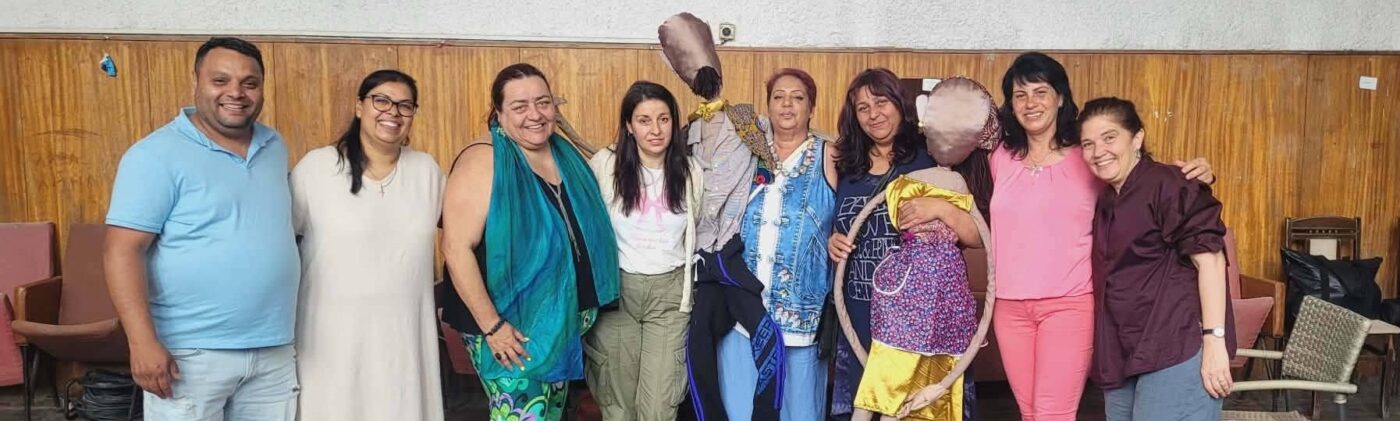
During the sessions, we used two life-sized stylised puppets—a male and a female—as innovative visual and communication tools to present the stories of people affected by human trafficking. This approach helped illustrate their experiences in a way that made the information more accessible and easier for participants to understand. The puppets proved highly effective in maintaining the audience’s attention throughout the sessions and facilitated deeper emotional engagement with the topics discussed.
The puppets have intentionally been created without faces, allowing them to represent any person who has experienced exploitation or trafficking. Through them, we told stories about fraudulent job offers, abusive working conditions, exploitation in the food industry, the experiences of blueberry pickers, and, most powerfully, cases involving the “marriage to a stranger” trafficking scheme.
During several of the events, women who had themselves been taken to Cyprus to enter into marriages with nationals of non-EU countries came forward spontaneously and shared their personal experiences with the audience. Their testimonies added exceptional authenticity and emotional impact to the discussions.
Information materials were distributed throughout the campaign, accompanied by practical recommendations for safe job searching abroad and effective prevention of human trafficking.
The information sessions were successfully completed and contributed significantly to increasing awareness among local communities about the risks of human trafficking and the importance of taking appropriate safety precautions before accepting employment abroad.

Special thanks go to artist Ina Valentinova, who created the two puppets, Yordanka and Sabri, especially for this initiative. They help us tell the stories of people who have become victims of trafficking. They speak with our voices, yet they have no faces, because they can represent every one of us. Anyone can become vulnerable to exploitation and human trafficking. Through awareness, education and cooperation, we can work together to prevent human trafficking and support vulnerable communities.
The project “Raising Awareness of the Risks of Human Trafficking and Supporting Victims of Trafficking” is funded under Bulgaria’s National Programme of the Internal Security Fund 2021–2027, with financial support from the European Union and the budget of the Republic of Bulgaria.