
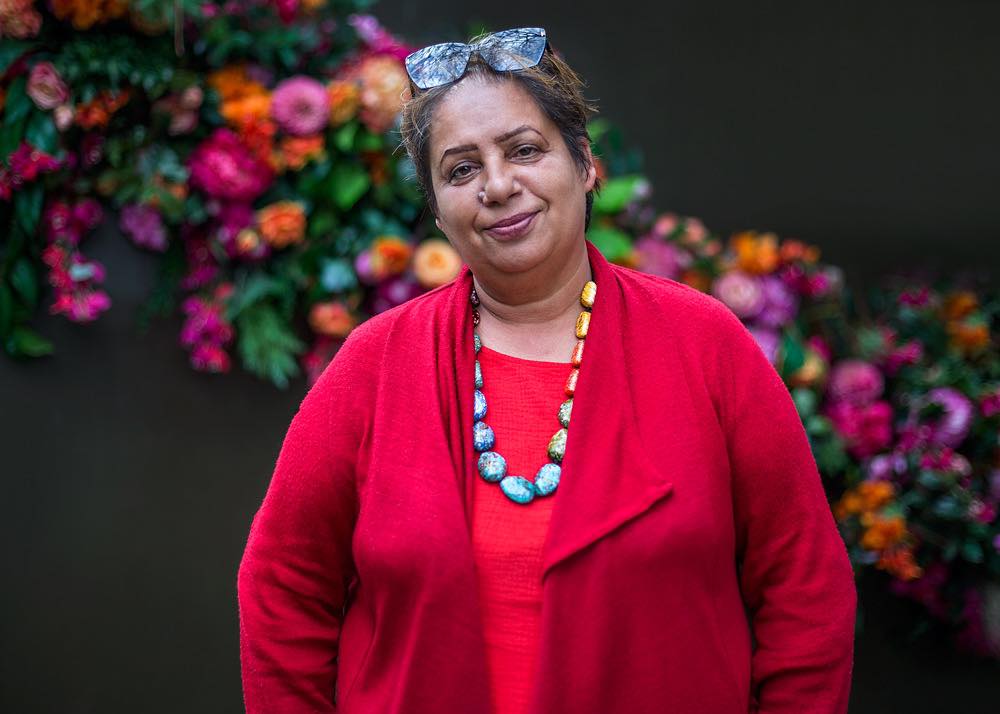
Katya Kirilova in front of People of Sofia
My name is Katya Kirilova and I have been a health mediator for 10 years. I have been working with the Roma community for 30 years. I have also dealt with children with addictions – the biggest problem of the Roma community is addictions.
How did you decide to become a health mediator?
I like community work, talking to people. I always try to help, pretend to be smart, because I’ve read a lot of books – to show my wits (laughs). Ever since she was little. My father, who was an ordinary laborer but had a subscription to the library, taught me to read books. I didn’t like to study lessons, even though I had a secondary education, but I was dying for books. At 15, I started with the Decameron because my father said that book wasn’t for me yet (laughs). I read it secretly in one night.
What does a health mediator do?
The health mediator is a bridge between institutions and people. Consults, helps, translates, if necessary, both to doctors and patients. To have an understanding so that it does not happen that one person understood one thing and it was another, etc. We are also a buffer. For example, there was a period when the maternity wards were occupied by Bulgarians on one floor and Roma on another. Under different conditions. It was very discriminatory and ugly, it annoyed me a lot. We started entering the Roma children’s ward, the doctors let us in because the mothers were running away and doing whatever they wanted. As I walked in, I began to understand why there were different wards. They went out into the corridor, hatching seeds, puppies, tearing the sheets – everything from the neighborhood was transferred there. I told myself, if it was me, I would keep them separate too – my sense of discrimination evaporated (laughs). One woman even started to beat the older sister for two leva – some things have to be paid for, so I stand between the two, I explain. Lots of stories. We teach them that they should carry forks and spoons, to keep, not to dirty, elementary things. I say to the parents of these girls – as you show your child, so will he do. If you wash your face in the morning, it will wash it too. If you tie your hair up in the morning and go to the coffee shop, it will do the same. You talk, you talk, it goes in one ear, out the other – complicated work, it doesn’t work. This in the children’s wards. Up in the neighborhood, we help with administrative issues – there are laws with articles and paragraphs that many people do not know. Not only the Roma, everyone. The state pays uninsured people some money to go to the hospital for treatment, but the doctors don’t say that. We say it, that’s why we sometimes come into conflict with doctors. We help in every way, not only to know their rights, but mainly their obligations.
The age limit has also dropped a lot, and they are now getting married at 12. Before, they were getting married at 16-17 years old. By the way, after the age of 16 you can sign a marriage with the consent of your parents.